Municipal suppression efforts deploy an estimated 500 to 3,000 gallons of water per room to extinguish a structure fire. In multistory hillside homes near Mount Washington or flat-roof commercial buildings along…
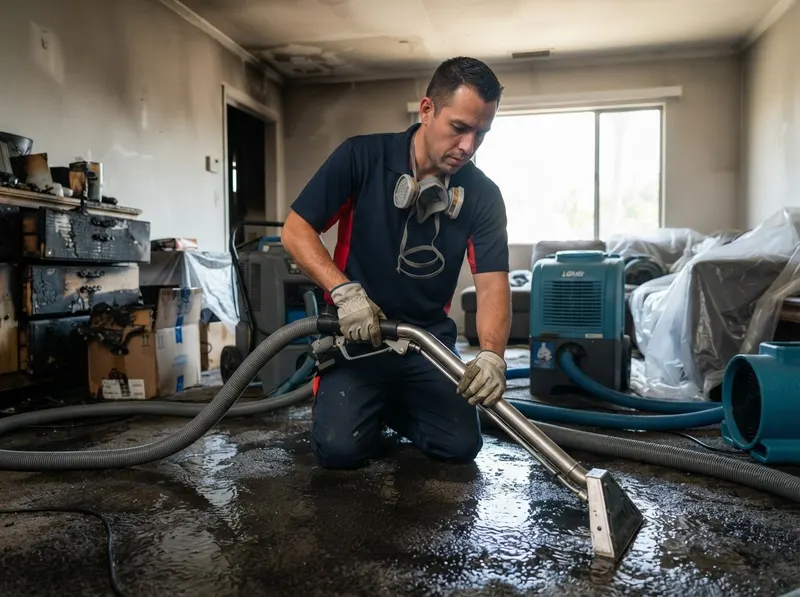
Municipal suppression efforts deploy an estimated 500 to 3,000 gallons of water per room to extinguish a structure fire. In multistory hillside homes near Mount Washington or flat-roof commercial buildings along Koreatown, this extinguishing volume flows down wall cavities, collects across subfloors, and saturates foundational sills. When clean tap water mixes with charred wood, toxic chemical fire retardants, and collapsed drywall, it immediately downgrades to Category 3 black water. If standing water remains trapped beneath hardwood floors in Sherman Oaks or behind plaster in historic Los Feliz residences for longer than 48 hours, microbial amplification begins, weakening load-bearing studs and doubling the eventual scope of demolition.
Structural drying targets preservation over unnecessary teardowns. Standard consumer fans merely circulate damp air, which accelerates wood warping and distributes airborne soot particles throughout unaffected spaces. Professional structural drying utilizes LGR (low-grain refrigerant) or desiccant dehumidifiers that lower relative humidity inside the structure to under 30%, pulling bound moisture out of concrete slabs, joists, and subfloors. Technicians continuously log psychrometric readings, measuring grains per pound (GPP) of moisture in the air and mapping moisture percentages in framing studs against dry baseline standards. This rigorous documentation ensures compliance with IICRC S500 guidelines and provides required proof for property insurance claim adjusters without unexpected billing surprises.
The logistical sequence begins with safety containment and water evacuation. Step 1: Technicians isolate live electrical circuits and execute thermal imaging sweeps to detect water pockets concealed within ceiling cavities and perimeter walls. Step 2: Truck-mounted extraction units and weighted subfloor extractors pull free-standing liquid from concrete, tile, and framing bases. Step 3: Damaged porous insulation and non-salvageable drywall are surgically removed along a measured flood line to open wall cavities. Step 4: Industrial negative-air scrubbers paired with desiccant dehumidification systems run continuously for 3 to 5 days, returning structural framing lumber to an equilibrium moisture content below 15%. This disciplined approach stabilizes structural framing across Venice, Woodland Hills, and Brentwood properties before secondary mold damages the foundation.
Every job gets a firm, written price after a free on-site visit.
Tell us about your firefighting water extraction and structural drying job in los angeles and we'll send a clear, written quote, usually the same day.
 First Fire Damage Restoration