Forced-air ventilation networks act as distribution loops for microscopic contaminants following a residential or commercial fire event. When building fires occur near mountain canyon corridors in Pacific Palisades or…
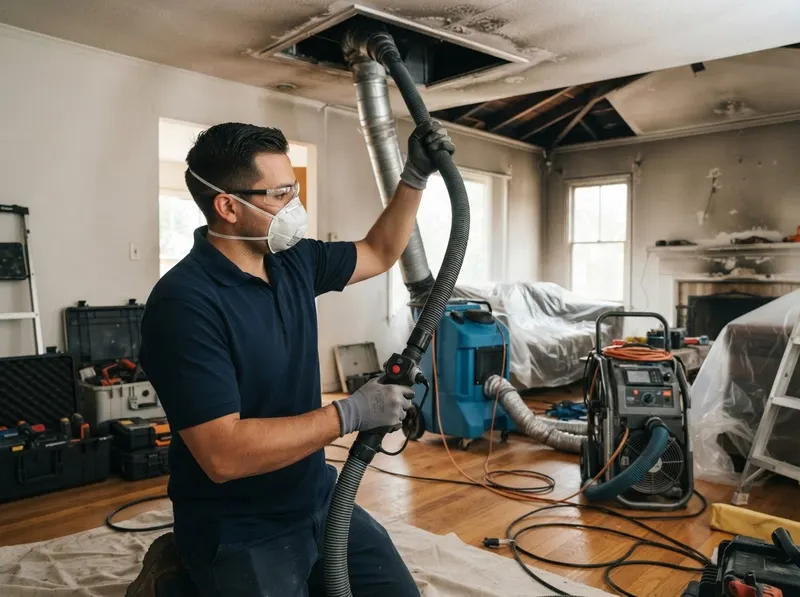
Forced-air ventilation networks act as distribution loops for microscopic contaminants following a residential or commercial fire event. When building fires occur near mountain canyon corridors in Pacific Palisades or older residential neighborhoods like Silver Lake and Highland Park, combustion particulates enter supply returns immediately. Cold soot and acidic carbon residues settle across interior duct walls, fiberglass insulation liners, and air handler blower wheels. If a mechanical system runs before decontamination, toxic chemical particulates and combustion residues re-enter livable spaces, creating persistent respiratory hazards and staining pristine finishes. Structural remediation requires physical soot detachment rather than masking agents. The process pairs mechanical duct sanitation with closed-loop HEPA air scrubbing rated at 99.97% containment down to 0.3 microns.
Air scrubbing protocols rely on continuous air changes per hour (ACH). In multi-story residences throughout Brentwood or historic craftsman layouts in Mount Washington and Los Feliz, sealed containment barriers isolate the work area while industrial negative air machines pull interior atmospheres through multi-stage pre-filters, activated carbon beds, and HEPA units. The technical differentiation rests on particulate load: surface duct wipe-downs handle nominal dust, but post-fire restoration requires negative pressure vacuums pulling 2,000 CFM to dislodge sticky synthetic soot without releasing ash back into ambient rooms. Running standalone consumer filters is insufficient for combustion cleanup because gaseous smoke odors penetrate ductwork linings. The proper standard applies thermal fogging or hydroxyl treatment only after mechanical air scrubbing has physically removed the particulate layer from the duct interiors.
Building layouts along coastal pockets like Venice experience marine moisture layers that bond heavy soot against the interior sheet metal of mechanical chases, while high-temperature valley microclimates in Sherman Oaks and Woodland Hills bake carbon deposits onto evaporator coils. First Fire Damage Restoration inspects each mechanical trunk line, register boot, and furnace plenum before operating the system. In commercial multi-tenant setups across Koreatown, fire suppression systems and municipal water hoses often douse adjacent ceilings, requiring simultaneous moisture control to prevent ductwork mold colonization. Technicians document pre-loss and post-cleaning particulate counter readings to verify mechanical clearance for insurance claims. Property owners can call (424) 540-2182 to coordinate structural duct evaluations or text a photo of the air handler for rapid scope assessments.
Every job gets a firm, written price after a free on-site visit.
Tell us about your hvac duct cleaning and air scrubbing job in los angeles and we'll send a clear, written quote, usually the same day.
 First Fire Damage Restoration